



Obstetrician-Gynecologist
PhD, University of Athens Medical School
Obstetrician-gynecologist Panagiotis Polyzos practices at the Institute of Life, the IVF Unit of IASO Maternity Hospital.

The chorionic villi consist of the cells that will form the placenta during pregnancy.
Chorionic villus sampling (CVS) involves examining these structures, the chorionic villi. Since both the fetus and the placenta originate from the same initial cell (the fertilized egg), their genetic material is identical.
It is performed from the 11th to the 14th week of pregnancy.
CVS is not scheduled earlier, because according to some studies, when performed before 10 weeks, there is a small risk of abnormalities in the fetal fingers and limbs.
Chorionic villus sampling is recommended: a) In cases of an inherited genetic condition (thalassemia, cystic fibrosis, etc.). b) When the pregnant woman is of advanced reproductive age. c) When there is an increased likelihood of Down syndrome (trisomy 21) or other chromosomal abnormalities, after the relevant prenatal screening. d) When there is a relevant medical history from a previous pregnancy.

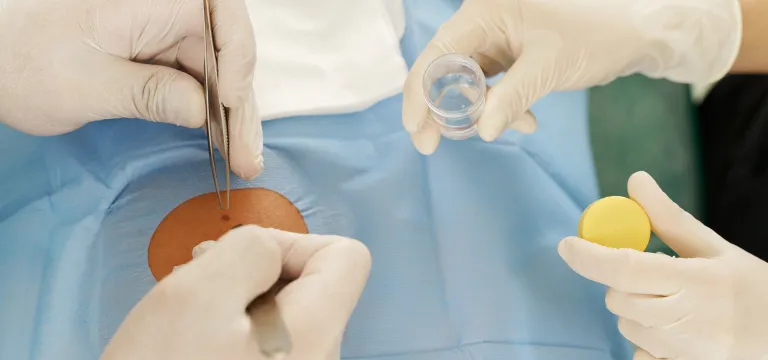
First, the position of the placenta and the fetus is checked by ultrasound. The appropriate area of the abdomen is disinfected, and local anesthesia is administered. Then, a thin needle is passed through the mother’s abdomen, and a sample of chorionic villi is aspirated, always under continuous ultrasound guidance.
The procedure lasts about 1 minute and is almost painless. Afterwards, the normal fetal heart rate is confirmed, and the pregnant woman can leave.
During the first two days, some symptoms may occur. However, in almost all cases, the pregnancy continues without problems. The pregnant woman may notice some abdominal discomfort, period-like pain, or light bleeding. It is therefore recommended to rest during this period and avoid any physical exertion.
A simple painkiller such as paracetamol can be used safely.
Rarely, within the following five days, signs of infection may appear, such as fever, heavy bleeding, or severe pain. In this case, the pregnant woman should contact her physician immediately.
Rarely, the results may be unclear due to inadequate sampling or contamination with maternal cells. In such cases, the procedure needs to be repeated.
Additionally, if mosaicism is identified in the examination result, amniocentesis must be performed later.
The risk of miscarriage due to CVS is approximately 0.25–0.5%, almost the same as that of amniocentesis at 16 weeks. If such a complication were to occur, it would happen within the following five days.
If the pregnant woman’s blood type is Rh-negative, a specific anti-D immunoglobulin is administered intramuscularly to prevent sensitization of the immune system.
The initial results for Down syndrome and other chromosomal abnormalities are usually available within 2–3 days, and the final results within 2 weeks. For rarer genetic conditions, approximately 2 weeks are required.
The most common method is transabdominal: the fine needle passes through the skin of the abdomen, as described above. There is also a transcervical technique, in which a thin, flexible catheter passes through the vagina and cervix to the placenta, again under continuous ultrasound guidance.
In experienced hands, the two techniques have similar safety. The doctor decides on the day of the test, after seeing the position of the placenta on ultrasound.
The trophoblast sample contains living cells with the same genetic material as the fetus. From this material the laboratory can run different analyses, depending on the indication.
That is why chorionic villus sampling does not replace the rest of your pregnancy testing. It complements it.
The prenatal screening process is divided into two categories of tests. Screening tests estimate a probability. Diagnostic tests, such as CVS, give a definitive answer.
Because the cell-free DNA in NIPT comes mainly from the placenta, as does the CVS sample, an abnormal finding may rarely involve only the placenta. In some cases, for this reason, the doctor will recommend amniocentesis instead of CVS or in addition to CVS.
The test is done at the office or in a maternal-fetal medicine unit and does not require a hospital stay. A little organization in advance makes the day calmer:
The laboratory report usually falls into one of the following categories:
Do not try to interpret the laboratory report on your own using the internet. The terminology is technical and correct interpretation requires knowledge of your full history.
In twin pregnancies the test is possible, but it is technically more demanding and is best done at a specialized center.
For many couples, the days until the result are the most stressful of the pregnancy. This is completely normal.
Genetic counseling before the test explains exactly what will be tested, how accurate the result is and what options you will have in each scenario. After the test, it helps you understand an unclear or abnormal finding without rushing into decisions.
Greece has one of the highest rates of beta thalassemia carriers in Europe. A carrier is healthy, often with mild microcytosis on a complete blood count. But when both parents are carriers, in each pregnancy there is a 25% chance that the child will be born with the disease.
For these couples, chorionic villus sampling is the test of choice, because it provides a molecular diagnosis as early as the first trimester. To do it properly:
Organizing these tests early determines whether the diagnosis can be made in time, in the first trimester.
Chorionic villus sampling is an invasive maternal-fetal medicine procedure. It is performed by an obstetrician with special training in invasive prenatal testing who carries out such procedures regularly.
Experience makes a measurable difference. The additional risk of pregnancy loss reported in recent studies refers to high-volume centers. An experienced operator usually needs only one needle insertion, obtains enough material on the first attempt and reduces the chance that the test will need to be repeated.
Equally important is the genetics laboratory that will analyze the sample. Ask which analyses will be done, at which laboratory and how long each result is expected to take.
Between weeks 11 and 14 of pregnancy.
When performed by an experienced doctor, the additional risk is very small, around 0.2% according to recent studies.
It causes a sting and a feeling of pressure or cramping for a few seconds.
The first result for the most common trisomies comes in two to three days, and the full analysis in about two weeks.
CVS gives an answer earlier. Amniocentesis is done from week 16. The choice depends on gestational age and the indication.
No. You can eat a light meal as usual. Your doctor will tell you whether you need a full or empty bladder, depending on the technique and the position of the placenta.
If you have a desk job and feel well, usually yes, after one to two days of rest. Avoid heavy physical exertion, lifting heavy objects and strenuous exercise for a few days.
Yes, chromosome analysis also shows the sex chromosomes. If you do not want to know, tell your doctor from the start so that it is not disclosed to you.
When the sampling is done for an inherited condition such as thalassemia, the carrier results of both parents are needed. Without them the laboratory does not know which mutation to look for. No tests are required from the father to check for chromosomal abnormalities.