


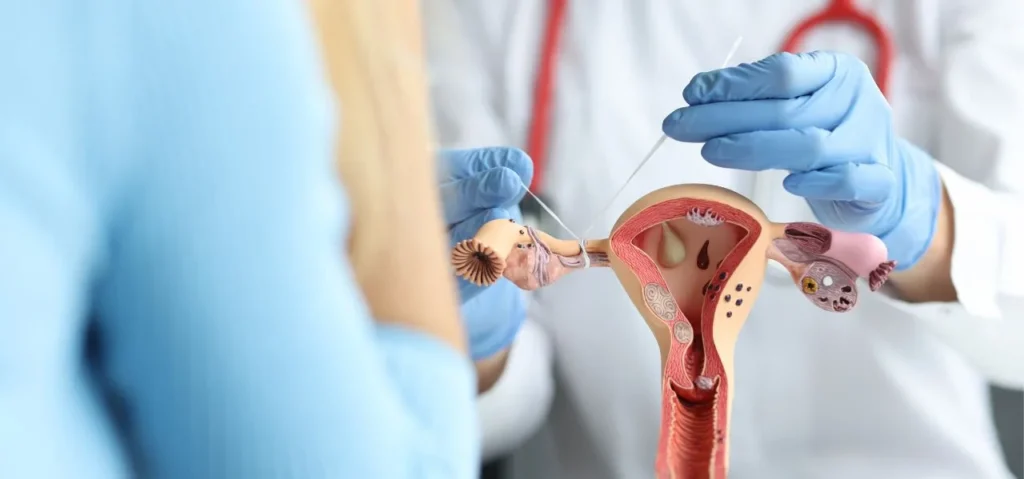
Classic salpingography (or hysterosalpingography) is a widely used, non-invasive diagnostic imaging method for the uterus and fallopian tubes. It has been in use for almost a hundred years and is mainly performed at a radiology center. It is a specialized test of fallopian tube patency, needed mainly in the investigation of female infertility.
How salpingography is performed
The test begins by introducing a contrast medium into the uterus through a special catheter. The contrast medium is then pushed under pressure into the fallopian tubes and flows out of them into the woman's pelvis. As the contrast medium advances, repeated pelvic X-rays are taken to check tubal patency.
Duration of examination and recovery
The duration of the salpingography is approximately 15 to 30 minutes. No special preparation is needed before the test, except when there is a history of gynecological inflammation. In that case, your gynecologist, in consultation with the radiologist, will always ask you to take a short, mild course of preventive antibiotics.
Salpingography is ideally performed between the 7th and 13th day of a woman's cycle, to avoid discomfort, pelvic pain or a possible fertilization that the test could harm.
After the examination and depending on the findings, your doctor may recommend a course of treatment, if necessary. There is no need for the patient to refrain from daily activities, work, exercise and routine after the examination.
Possible side effects
A rare complication of both classic salpingography and sonosalpingography is an allergic reaction, which is directly related to the contrast medium used during the test. Also, some women have occasionally reported discomfort and mild pain during the test, so mild painkillers, mainly acetaminophen (paracetamol), are recommended both before and after the test for women who are sensitive or have a low pain tolerance.
Finally, there have been some minor concerns about radiation exposure of the ovaries, though without certainty or scientifically established views, since we do not know with absolute certainty what radiation threshold is considered safe for the ovaries.
Sonosalpingography (HyCoSy)
Sonosalpingography is usually performed at a gynecology office or clinic using ultrasound and a thin silicone catheter. Through the cervix, the doctor introduces a special contrast fluid with the silicone catheter in order to visualize the fallopian tubes and the free spill of the contrast medium, under simultaneous ultrasound guidance.
What does it cost?
The cost of both salpingography and sonosalpingography varies and depends entirely on the doctor and the diagnostic center you carefully choose.
When hysterosalpingography is needed
- As part of a couple's basic workup, after 12 months of trying without pregnancy, or 6 months if the woman is over 35.
- Earlier, when there is a history of pelvic inflammatory disease, chlamydia, ectopic pregnancy or pelvic surgery.
- Before intrauterine insemination (IUI), since the method requires at least one open fallopian tube.
- To check the shape of the uterus in cases of recurrent miscarriage.
Preparing for the test
- Schedule the test after your period ends and before ovulation, that is, between day 7 and day 12 of the cycle.
- Avoid unprotected intercourse from the start of the cycle until the test.
- A simple pain reliever taken 30 to 60 minutes beforehand reduces discomfort.
- Tell the doctor about any allergy to iodine or contrast agents and about any active infection. With vaginitis or cervicitis, the test is postponed.
Does hysterosalpingography hurt?
Most women describe period-like cramps that last as long as the contrast is being injected, about one to two minutes. The pain is stronger when the tubes are blocked, because the fluid has no way out. It eases quickly once the injection is finished.
What the results show
- Open tubes: the contrast passes through both tubes and spreads freely into the pelvis.
- Blockage near the uterus: sometimes this is due to a temporary spasm rather than real damage. It is confirmed by repeating the test or with laparoscopy.
- Blockage at the far end and hydrosalpinx: the tube swells and fills with fluid. A hydrosalpinx lowers IVF success rates and is usually treated surgically before treatment.
- Findings in the uterus: polyps, submucosal fibroids, a septum or adhesions, which are evaluated further with hysteroscopy.
When the tubes are damaged, the options are laparoscopic tubal surgery or in vitro fertilization, depending on the extent of the damage and age.
After the test
Light bleeding or watery discharge and mild cramps for one to two days are expected. Contact your doctor if you develop a fever, foul-smelling discharge, severe pain that persists or bleeding like a period.
Where hysterosalpingography fits in a couple's fertility workup
Hysterosalpingography is not the first test done when a couple has trouble conceiving. The basic workup follows a logical order, so that invasive procedures are not done unnecessarily:
- Semen analysis: a simple, inexpensive and often revealing test. If there is severe male factor infertility, the strategy changes before any testing of the tubes.
- Confirming ovulation: through the cycle history and, where needed, hormone tests or ultrasound monitoring.
- Ovarian reserve: AMH and an ultrasound follicle count.
- Tubal patency testing: in women with no history suggesting pelvic disease, hysterosalpingography or sonohysterosalpingography is the first-line test. When endometriosis, adhesions or a previous infection is suspected, the doctor may prefer laparoscopy with dye injection, which provides more information.
The goal is not to do every test. It is to do the right ones, in the right order, so that the couple quickly reaches a clear plan.
Water-based or oil-based contrast: what changes
Hysterosalpingography can be done with two types of contrast.
- Water-based (water-soluble): the most widely used. It is absorbed quickly and gives a good picture of the uterus and tubes.
- Oil-based: thicker, it stays longer in the pelvis. A large randomized study in women with a good prognosis showed higher pregnancy rates in the months after hysterosalpingography with oil-based contrast, compared with water-based contrast. The mechanism is not fully understood. It probably “flushes” mucus or debris out of the tubes.
Oil-based contrast also has its own particularities. It contains a large amount of iodine, which can temporarily affect thyroid function, so women with thyroid disease need testing before and after. Rarely, the oil passes into the blood vessels of the uterus. The choice is made individually, in consultation with the gynecologist and the radiologist.
How reliable is hysterosalpingography
No test is perfect, and it helps to know the limits of hysterosalpingography before you read the result.
- When it shows open tubes, they usually are open. In this respect the test is very reliable.
- When it shows a blockage, especially near the uterus, the tube may actually be open. A uterine spasm, some mucus or a little pressure during the injection is enough to “close” the entrance temporarily. That is why such a finding is often confirmed with a second method.
- What it does not show: it does not image the ovaries, it does not detect superficial endometriosis and it does not always show adhesions around the tubes. An open tube is not necessarily a functional tube.
Newer methods: foam sonohysterosalpingography
A development of sonohysterosalpingography uses a special foam instead of liquid contrast, which is clearly visible on ultrasound as it passes through the tubes. It is done in the office, without radiation and without iodinated contrast. In a large randomized study, women tested with foam had similar chances of a live birth to those who had standard hysterosalpingography. It is therefore a reliable alternative, especially for women with an iodine allergy or who prefer to avoid radiation. Image quality depends greatly on the examiner's experience.
Special situations before hysterosalpingography
Allergy to contrast agents or iodine
Be sure to tell the center. Sonohysterosalpingography, which does not use iodinated contrast, is usually preferred. If the standard test is necessary, the doctor may recommend preventive medication.
History of infection or a positive chlamydia test
The test can “push” germs from the cervix toward the tubes. That is why chlamydia testing before the procedure or preventive antibiotics are recommended, especially when there is a history of pelvic inflammatory disease or hydrosalpinx.
Breastfeeding
Breastfeeding is not an obstacle. The contrast agents used pass into breast milk in negligible amounts. What matters is that your cycle has returned, so the test can be scheduled correctly.
Irregular cycle
If your periods are infrequent or unpredictable, scheduling is more difficult. A pregnancy test on the day of the procedure rules out an unknown pregnancy.
One blocked tube: what it means for conception
A common finding is a blockage in only one tube. It does not mean infertility. The open tube can “pick up” eggs from both ovaries, and many women conceive naturally. If trying continues without success, intrauterine insemination (IUI) in cycles where ovulation occurs on the side of the open tube is a reasonable option. When the blocked tube is swollen with fluid, it is treated first, because the fluid affects implantation. For practical tips while you are trying, read about how to get pregnant.
How to read the terms in the report
The hysterosalpingography report is written in medical language. Some terms you will often come across:
- “Free bilateral spill of contrast”: both tubes are open. The best possible finding.
- “Proximal blockage” or “non-filling of the tube”: the contrast did not enter the tube. It may be a real blockage or a spasm, and it needs confirmation.
- “Distal blockage” or “dilated tube”: the tube fills but the contrast does not come out of its end. This often means a hydrosalpinx.
- “Loculation” or “restricted spill”: the contrast comes out but collects in a pocket, a sign of possible adhesions around the tube.
- “Filling defect of the cavity”: something inside the uterus prevents the contrast from filling it evenly, such as a polyp, a fibroid or adhesions.
Do not draw conclusions from the report on your own. The significance of each finding is judged together with the rest of your history.
Misconceptions about hysterosalpingography
- “It is a very painful test.” Most women describe it as a strong cramp that lasts a few minutes. A pain reliever beforehand helps a lot.
- “The radiation harms the eggs.” The dose is small and the test is done before ovulation, so that no fertilized egg is exposed.
- “If the tubes are open, everything is fine.” Tubal patency is only one piece of the puzzle. Ovulation, sperm and ovarian reserve matter just as much.
- “A blockage result is final.” Not always. A proximal blockage in particular is confirmed before any decisions are made.
What to bring on the day of the test
- The referral and any previous tests, such as ultrasounds or an earlier hysterosalpingography, for comparison.
- Your chlamydia test results, if you have had one.
- Sanitary pads, because after the test the contrast and a little blood come out of the vagina.
- A pain reliever, if you have not already taken one.
- Someone to accompany you, if you are worried about dizziness or discomfort, although most women leave on their own without any problem.
Ask to take the test images with you as well, not just the written report. Your gynecologist will assess them better by seeing the flow of the contrast firsthand.
Frequently Asked Questions
On which days of the cycle is hysterosalpingography done?
After your period ends and before ovulation, usually from day 7 to day 12, so that the possibility of pregnancy is ruled out.
Does hysterosalpingography increase the chances of pregnancy?
Several studies show a small increase in fertility in the first months after the test, mainly when oil-based contrast is used. Still, the test is done for diagnosis, not as a treatment.
When can I try to get pregnant after the test?
From the same cycle, unless your doctor advises otherwise.
Hysterosalpingography or sonohysterosalpingography?
Sonohysterosalpingography involves no radiation or iodinated contrast and is done in the office. Standard hysterosalpingography gives a more detailed picture of the course of the tubes. The choice depends on your history.
Can I go to work afterward?
Yes. Most women return to their activities the same day.
Can I have hysterosalpingography while breastfeeding?
Yes. Contrast agents pass into breast milk in negligible amounts, and there is no need to stop breastfeeding. Your cycle just needs to have returned so the test can be done on the right days.
Do I need antibiotics before hysterosalpingography?
Not for all women. They are recommended when chlamydia testing has not been done, or when there is a history of pelvic inflammatory disease or a suspected hydrosalpinx, to lower the risk of infection after the test.
If one tube is blocked, can I get pregnant naturally?
Yes. The open tube can pick up eggs from both ovaries. Many women with one open tube conceive without help, although it may take longer.
Does oil-based contrast affect the thyroid?
It can, because it contains a large amount of iodine. In women with known thyroid disease, thyroid function is checked before and after the test, especially if a pregnancy may follow soon.