


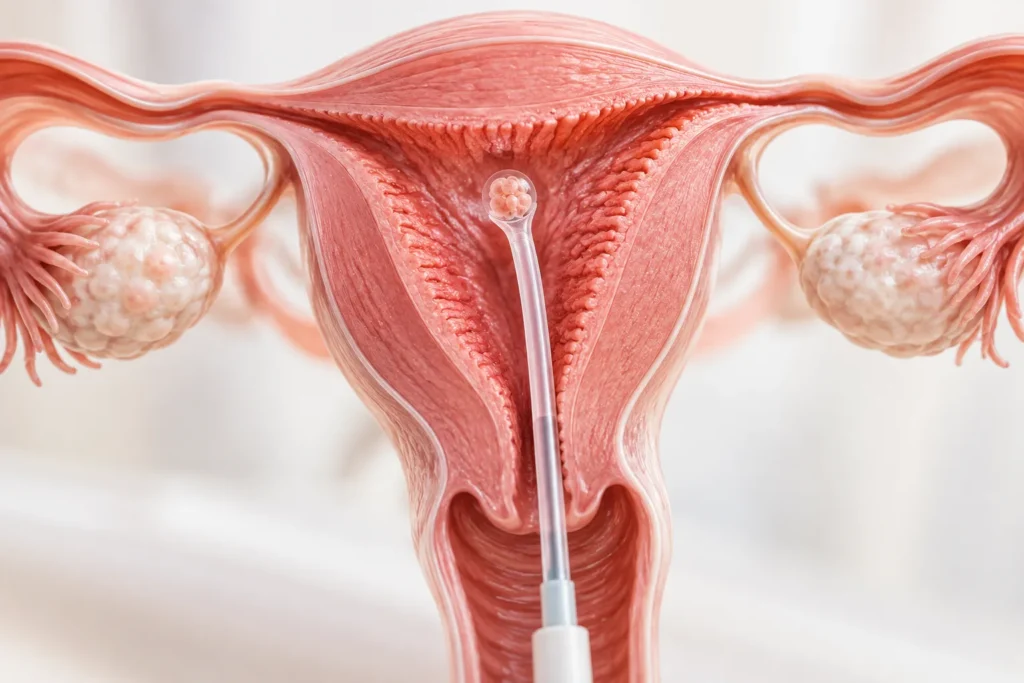
Before embryo transfer, endometrial thickness is one of the factors the medical team checks. The measurement matters, but on its own it is not enough to predict implantation. It is assessed together with morphology, the protocol, your history and the characteristics of the embryo.
What the Endometrium Is and Why It Matters
The endometrium is the inner lining of the uterus. Under the influence of estrogen it grows and becomes thicker. After ovulation or the administration of progesterone in a properly prepared cycle, it undergoes changes that are part of the preparation for implantation.
Endometrial receptivity changes during the cycle. Planning the embryo transfer involves synchronizing it with embryo development and appropriate exposure to progesterone, without guaranteeing success.
How Endometrial Thickness Is Measured
The measurement is taken by transvaginal ultrasound, in the longitudinal view of the uterus, at the point where the endometrium is thickest. The total thickness of both layers is measured, from one side of the cavity to the other.
Besides thickness, the doctor also assesses morphology. The so-called “triple-line” or trilaminar endometrium, with three distinct lines, is the characteristic finding of the proliferative phase and is considered favorable. At the same time, the doctor checks for polyps, fibroids or fluid inside the cavity.
What Thickness Is Considered Ideal
There is no universally accepted “ideal” thickness, nor a cutoff that on its own determines whether a transfer should go ahead. The table summarizes indicative categories, not cancellation rules:
| Endometrial thickness | What it usually means |
|---|---|
| Under 6 mm | Thin endometrium; associated with lower chances, but does not rule out pregnancy. The decision is individualized. |
| 6–7 mm | Low measurement; morphology, the cycle and your history are taken into account, with no automatic cancellation. |
| 7–14 mm | A commonly accepted range in clinical practice, with no universal ideal cutoff or guarantee of implantation. |
| Over 14 mm | Not a diagnosis of a problem on its own. Morphology, cycle phase and symptoms are taken into account. |
A thin endometrium, often defined in studies with a 7 mm cutoff, has been associated with lower success rates. Findings vary by type of cycle and by study. They do not show that chances level off exactly at 7-8 mm, or that a specific thickness guarantees pregnancy.
How Reliable Thickness Is as a Predictor
Thickness has limited value as a standalone predictor. Pregnancies can be achieved even with a thin endometrium, while a higher measurement does not guarantee implantation.
The developmental and chromosomal status of the embryo also affects the outcome. Age at the time of egg retrieval is an important factor. The decision on preimplantation genetic testing (PGT) is made when there is a specific indication. Testing is not necessary for all women, nor does it guarantee a live birth.
Fresh or Frozen Embryo Transfer: Is There a Difference?
In a fresh embryo transfer, the endometrium develops alongside ovarian stimulation. Very high hormone levels can sometimes affect endometrial synchronization, even when the thickness is good.
The embryo cryopreservation process allows the endometrium to be prepared in a later natural, modified natural or medicated cycle. If the picture is not suitable, the plan can be adjusted or the transfer postponed.
Why an Endometrium Stays Thin
Possible factors that are investigated, depending on your history, include:
- Intrauterine adhesions (Asherman syndrome): usually after D&C procedures, miscarriages or uterine surgery.
- Chronic endometritis: low-grade inflammation that often causes no symptoms.
- Factors related to blood flow and endometrial response, which cannot be diagnosed from the measurement of thickness alone.
- Low response to estrogen: in some women, even without an obvious cause.
- Previous radiation therapy to the pelvis or other treatments that may affect ovarian and uterine function.
What We Do When the Endometrium Is Thin
First, the measurement, your history and the hormonal preparation are reassessed. Depending on the findings, the following may be discussed:
- Hysteroscopy: allows direct assessment of the cavity, release of adhesions, removal of polyps and a biopsy for endometritis.
- Adjusting the hormonal preparation: changes to the duration, dose or route of estrogen administration, or to the type of cycle, only on medical advice.
- Investigation and treatment of chronic endometritis, when there is a relevant indication and confirmation, with information about the limits of the evidence.
- Lifestyle changes: quitting smoking, physical activity, a healthy body weight.
- Interventions such as intrauterine PRP or G-CSF remain under investigation. Their effectiveness and safety have not been sufficiently established for routine use.
In rare cases of severe, irreversible uterine disease, other reproductive options may be discussed. Opting for surrogacy requires a separate medical and legal assessment; it is not a conclusion drawn from a single measurement.
Can I Help My Endometrium?
There is no food or supplement that reliably “thickens” the endometrium. What really helps is taking your medication exactly as prescribed, avoiding smoking, a balanced diet, gentle exercise and enough sleep. Avoid taking any products without telling your doctor, because some may interact with hormone therapy.
How the endometrium changes during the cycle
Endometrial thickness is not fixed. It changes from day to day depending on hormones, which is why a measurement only makes sense when we know in which phase it was taken.
- Period: the functional layer is shed and the endometrium is thin, usually about 1 to 4 mm.
- Proliferative phase: as estrogen rises, it gradually thickens and takes on the “triple-line” appearance.
- Around ovulation: it usually reaches 8 to 12 mm, with big differences from woman to woman.
- Secretory phase: under the influence of progesterone it becomes brighter (hyperechoic) on ultrasound, and the thickness stabilizes.
After menopause the situation is completely different. There, a thin endometrium is normal and assessment follows other criteria.
When measurements are taken in the preparation cycle
The number and timing of ultrasounds depend on the type of cycle chosen for the embryo transfer.
Medicated cycle
A first ultrasound at the start of the cycle confirms that the endometrium is thin and that there are no cysts. Estrogen is then given for about 10 to 14 days, followed by a new measurement. If the picture is satisfactory, progesterone is added and the transfer day is set. If not, treatment may be extended or adjusted.
Natural or modified natural cycle
Here the endometrium is measured along with the growth of the dominant follicle, usually over two or three visits. Blood hormones such as LH and progesterone may also be checked to pinpoint ovulation precisely.
In every case, measurements are taken with the same technique and ideally by the same doctor, so they can be compared with each other.
Morphology, blood flow and other ultrasound findings
Thickness is a number. The image, however, gives more information:
- A uniform, bright endometrium before progesterone starts: may mean a premature progesterone effect and leads to rechecking the hormones.
- Fluid inside the cavity: in some cases it is linked to hydrosalpinx, a fluid-filled fallopian tube, which has a negative effect on implantation and needs investigation.
- Irregular outline or focal thickening: may suggest a polyp, a submucosal fibroid or adhesions.
- Doppler blood flow: is being studied in research. The data are not enough to decide on a transfer based on blood flow alone.
Some centers also use 3D ultrasound, which better shows the shape of the cavity and possible congenital uterine anomalies.
Endometrial compaction after progesterone
In recent years, so-called endometrial “compaction” has been studied: a small decrease in thickness after progesterone starts, as a sign that the endometrium is responding properly. Some studies linked it to better outcomes, while others found no difference. So it is not a routine criterion. If the measurement on transfer day shows a slightly lower thickness than a few days earlier, it is no cause for concern.
Thick or irregular endometrium: when testing is needed
A thick endometrium in a woman of reproductive age is usually a normal finding in the second half of the cycle. However, further testing is needed when it occurs together with:
- Irregular or heavy bleeding, or bleeding between periods.
- Long cycles without ovulation, as often happens with polycystic ovaries, where estrogen acts without the counterbalancing effect of progesterone.
- Obesity, diabetes or tamoxifen use.
- Focal thickening that stays the same on repeated measurements.
In these cases, hysteroscopy or endometrial biopsy is recommended to rule out polyps and hyperplasia before preparing for a transfer.
Tests after recurrent implantation failure
When good-quality embryos fail to implant after repeated transfers, the investigation also turns to the uterus. Testing is individualized, but it often includes:
- Hysteroscopy to check the cavity.
- Endometrial biopsy for chronic endometritis, when indicated.
- Testing for hydrosalpinx.
- Reassessment of the embryos, the age of the eggs and the hormonal protocol.
Tests such as endometrial receptivity analysis (ERA), for a “personalized” transfer timing, are widely offered. However, randomized studies have not shown a clear benefit in live birth rates, which is why the recommendations of the European Society of Human Reproduction and Embryology (ESHRE) do not suggest them as routine tests.
Age, medications and the endometrium
With age, it is mainly the number and quality of eggs that decline. The endometrium largely keeps its ability to receive an embryo when it gets the right hormonal support. This is clearly seen in egg donation, where older women achieve pregnancy rates that correspond more closely to the donor's age.
Factors that may temporarily affect thickness:
- Taking birth control pills or other progestins in the previous month.
- Clomiphene in ovulation induction cycles, which can thin the endometrium.
- The route of estrogen administration (oral, transdermal or vaginal), which changes absorption.
If any of these factors applies to you, mention it before preparation starts. A simple change to the schedule, such as stopping a pill a month earlier or changing the route of estrogen administration, can make a difference to the next cycle's measurement.
Questions to discuss with your doctor
- What were the thickness and morphology of my endometrium in previous cycles?
- Which type of preparation cycle best suits my history?
- Do I need a hysteroscopy or other testing before the next transfer?
- What happens if my endometrium does not reach the target thickness in this cycle?
An open discussion helps you know in advance what scenarios exist, so that a possible postponement does not feel like a failure.
Myths and facts about endometrial thickness
- “The thicker, the better.” No. Beyond an adequate thickness, further increases do not seem to improve the chances of implantation.
- “A thin endometrium is to blame for every failure.” The most common cause of implantation failure remains the chromosomal status of the embryo, which is mainly related to the age of the eggs.
- “Vaginal sildenafil solves the problem.” It has been tried in small studies without sufficient proof of benefit, and it is not a routine treatment.
- “Aspirin thickens the endometrium.” The data do not show a clear benefit. It is taken only when there is a specific medical indication.
Conclusion
Endometrial thickness is assessed in the context of the overall picture. When it remains thin, the priorities are reassessing the preparation and targeted investigation, with a realistic discussion about the chances of transferring or postponing.
For a personalized assessment and planning of your embryo transfer, book an appointment with Dr. Panagiotis Polyzos at the Athens or Volos office. IVF treatments are performed at the Institute of Life IASO.
Frequently Asked Questions
What is the ideal endometrial thickness for embryo transfer?
There is no single ideal thickness for all women. A thickness of 7-8 mm is often used as a reference point, but the decision is not based on the measurement alone.
Can pregnancy happen with an endometrium under 7 mm?
Yes, pregnancies have been reported with a thinner endometrium, although the chances are statistically lower. The decision to transfer or postpone is made on an individual basis.
Is a very thick endometrium bad?
A greater thickness does not automatically mean a problem or hyperplasia. The cycle phase, morphology, bleeding and your history are taken into account to decide whether testing is needed.
What happens if the endometrium does not thicken in a frozen transfer cycle?
Your doctor may adjust the preparation or postpone the transfer. With a persistently thin endometrium, hysteroscopy may be considered, especially when adhesions are suspected.
Are there foods that thicken the endometrium?
There is no scientific proof that any specific food increases endometrial thickness. A balanced diet and avoiding smoking support the overall health of the uterus.
Can my endometrium be thin because I was taking birth control pills?
Yes, temporarily. Taking contraceptive pills keeps the endometrium thin while you are on them. After stopping, the response to estrogen usually returns within one to two cycles.
Does spotting during the preparation cycle affect the measurement?
Light spotting while taking estrogen does not necessarily mean a problem. However, let your team know, because an earlier ultrasound or hormone testing may be needed before progesterone starts.
Does morphology matter more than thickness?
They are assessed together. A triple-line endometrium with borderline thickness may be considered suitable, while a thick but irregular one needs more testing. The decision is based on the overall picture and your history.
Can endometrial thickness differ from cycle to cycle?
Yes. It can vary by a few millimeters between cycles, even with the same treatment. That is why one cycle with a thin endometrium does not mean the same will happen in the next.