

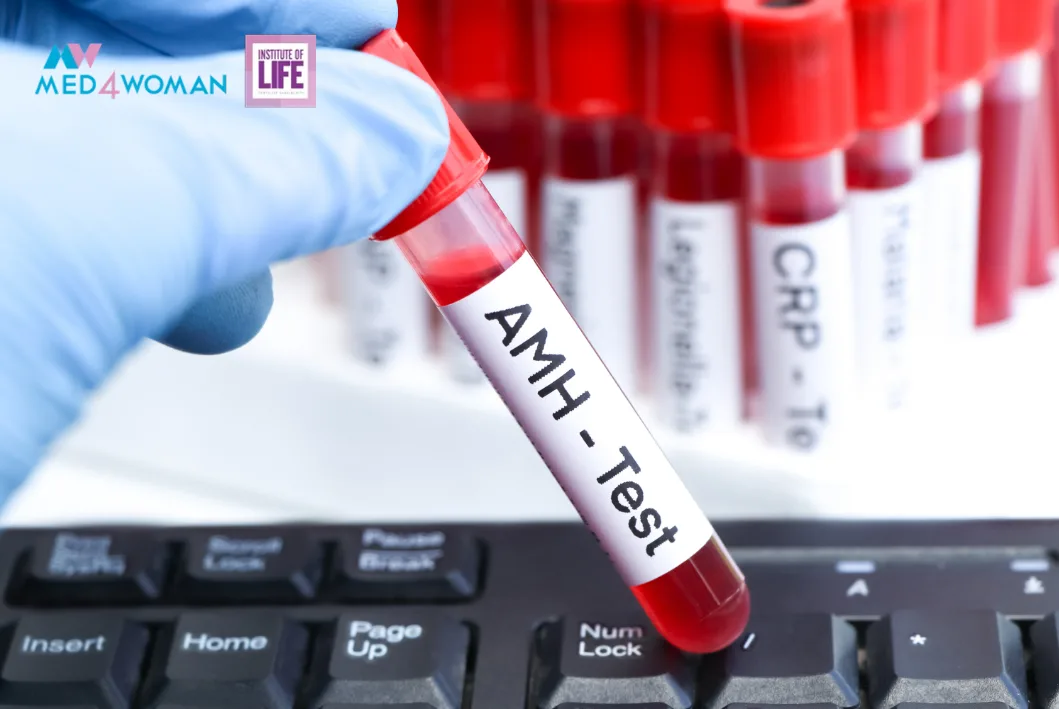
The anti-Müllerian hormone (AMH) is today one of the most reliable and widely used markers for assessing female fertility. With a simple blood test, the gynecologist can get important information about the “ovarian reserve,” that is, the number of eggs the ovaries have at a given time. In this guide we explain what AMH measures, what the normal values are by age and what we do when levels are low.
What Is Anti-Müllerian Hormone?
AMH is a hormone produced by the cells of the small, growing follicles inside the ovaries. The more active follicles there are, the higher the AMH level in the blood. That is why its value works as a “mirror” of the ovarian reserve, an estimate of fertility potential, but not of the actual ability to conceive.
Unlike other hormones that change during the cycle, AMH stays relatively stable and can be measured on any day, even when a woman is taking birth control, although values may then be slightly lower.
Why the Test Is Done
AMH testing is requested in various situations and benefits a wide range of women:
- To investigate infertility when conception is delayed.
- Before planning IVF (in vitro fertilization), to plan the right dose of hormonal stimulation.
- Before egg freezing, to estimate how many eggs can be retrieved.
- When premature menopause is suspected, or when there is a family history of early fertility decline.
- When investigating polycystic ovaries, where AMH is usually elevated.
Normal AMH Levels by Age
AMH levels vary considerably between women and, above all, decline naturally with age. As a rough guide, the following general trends are seen:
- In women under 30, levels are usually higher.
- Between 30 and 35, there is a gradual decline.
- After 35, and especially after 40, AMH drops noticeably.
- As menopause approaches, levels become almost undetectable.
It is important to be clear: reference ranges differ from laboratory to laboratory, and interpretation should be done by your treating doctor within the overall clinical picture, based on age, history and other tests. An AMH value “outside the averages” does not necessarily mean there is a problem.
What Low or High AMH Means
Low AMH
It suggests a diminished ovarian reserve, meaning fewer available eggs than expected for your age. This does not mean you cannot conceive, but it may lower the chances per month and make time more pressing. In these cases, the doctor may suggest a personalized plan that includes closer monitoring, assisted reproduction or, in some cases, egg donation.
High AMH
It is often seen in women with polycystic ovaries. It shows an abundance of small follicles, but not necessarily better fertility, since ovulation may be disrupted, and care is needed when adjusting hormonal stimulation in IVF to avoid hyperstimulation.
What AMH Does Not Tell You
AMH is a powerful marker, but it is not a “crystal ball.” It does not reveal egg quality, which depends mainly on age. It does not accurately predict when menopause will come, nor does it show whether a particular woman will get pregnant easily this month. That is why it is always combined with other tests: a hormone profile, ultrasound and clinical evaluation.
When You Should Check Your AMH
If you are over 30 and plan a pregnancy in the future, if you have been trying for a baby without success for more than 6 to 12 months, if you have a family history of early menopause or you are thinking about delaying motherhood, AMH testing can give you important information. Your doctor will combine the result with your history and suggest the right next step.
How the AMH test is done and what affects the result
AMH is measured with a simple blood draw. No fasting or specific cycle day is needed. However, the value is affected by factors that are worth knowing before you compare it with charts on the internet.
Units of measurement
Laboratories report the result either in ng/ml or in pmol/L. The conversion is about 1 ng/ml to 7.14 pmol/L. So a value of 7 can be low or high, depending on the unit. Always check which unit is shown on your result.
Differences between laboratories
There are different measurement methods, and they do not give exactly the same numbers. If you want to compare two measurements over time, have them done at the same laboratory.
Factors that lower AMH temporarily or permanently
- Hormonal contraception: birth control pills may lower the value, usually reversibly within a few months of stopping.
- Smoking: it is linked to lower values and a faster decline of the reserve.
- Ovarian surgery: mainly the removal of endometriomas.
- Chemotherapy or radiation therapy: they can cause a significant and often permanent drop.
- Pregnancy: AMH decreases temporarily during pregnancy.
If any of these applies to you, tell your doctor. It changes how the result is interpreted.
AMH and ultrasound follicle count: two complementary tests
AMH is rarely assessed on its own. The gynecologist usually combines it with the antral follicle count (AFC) on transvaginal ultrasound. This scan is done in the first days of the cycle and counts the small follicles, about 2 to 10 millimeters, in both ovaries.
- AMH: an objective blood value, independent of the cycle day, but affected by the laboratory’s method.
- AFC: a direct view of the ovaries, which depends on the examiner’s experience and the quality of the equipment.
- FSH and estradiol: measured on days 2 to 4 of the cycle, they provide complementary information, mainly when the other two tests do not agree.
When AMH and AFC point in the same direction, the estimate of the reserve is more reliable. When they disagree, the doctor weighs age and history or repeats the measurements.
How AMH is used in IVF
In assisted reproduction, AMH is one of the best markers of how well the ovaries will respond to stimulation. It does not, however, predict whether a pregnancy will be achieved. This distinction is crucial.
- Low AMH: fewer eggs are expected. The doctor may suggest a higher dose, mild stimulation or embryo banking over several cycles. Age determines the chances far more: a young woman with low AMH often has a better prognosis than an older woman with a normal value.
- Normal AMH: a standard dose is usually chosen, adjusted for weight and history.
- High AMH: the dose is lowered and an antagonist protocol is preferred to limit the risk of hyperstimulation. Embryos are often frozen and transferred in a later cycle.
For women with low AMH who respond poorly to stimulation, one option is Mini IVF, with milder medication.
AMH after ovarian surgery
Removing cysts from the ovaries can also remove healthy tissue containing follicles. The risk is greater with endometriomas, the cysts associated with endometriosis, especially when they are on both sides or when a second operation is needed.
For this reason, AMH is often measured before surgery. If the value is already low, the team discusses whether the operation is necessary or whether fertility preservation should come first. Not every cyst needs surgery, though. Most functional ovarian cysts resolve on their own and do not affect AMH.
AMH in special situations
Before cancer treatment
In women who are about to have chemotherapy, AMH helps plan fertility preservation. It shows roughly how many eggs can be retrieved in one cycle, so that the limited time before treatment is used as well as possible.
Close to menopause
A very low AMH in a woman over 45 shows that the reserve is running out. However, the diagnosis of perimenopause is made mainly on the basis of symptoms and the menstrual cycle, not a single test. Contraception should continue until menopause is confirmed, even with low AMH.
Premature ovarian insufficiency
If periods become infrequent or stop before age 40, AMH together with FSH helps with the diagnosis. The condition needs specialized follow-up, because it also affects bone health and cardiovascular health.
A practical plan after your AMH result
The next step depends mainly on your age and on when you want a child:
- Under 35, normal AMH, no immediate plans: no action beyond your annual gynecological checkup. Do not repeat the test every few months.
- Under 35, low AMH: repeat the test at a reliable laboratory, have a follicle count and discuss timing. If a baby is not in your immediate plans, seriously consider fertility preservation.
- Over 35 and already trying: if you are not pregnant within 6 months, start a full fertility workup for both partners, regardless of the value.
- High AMH with irregular cycles: evaluation for polycystic ovary syndrome and for whether ovulation is regular.
The most useful step is to discuss the result with a gynecologist who specializes in fertility. A number without context often causes more anxiety than help.
Myths and misconceptions about anti-Müllerian hormone
- “Low AMH means I can’t get pregnant.” No. AMH measures the number of follicles, not the ability to conceive. One mature, healthy egg a month is enough for a pregnancy.
- “High AMH means I am very fertile.” Not necessarily. It often goes along with polycystic ovaries, where ovulation can be irregular.
- “My AMH told me when I will reach menopause.” It only gives a general indication. The exact age of menopause cannot be predicted from a single value.
- “Supplements will raise my AMH.” No treatment has been shown to substantially increase the reserve. Small variations between measurements are usually due to the laboratory.
- “If my AMH is good, I don’t need any other tests.” Wrong. A normal value does not rule out blocked fallopian tubes, endometriosis or a male factor.
Questions to ask your doctor
- Is my value expected for my age?
- Does it match the follicle count on ultrasound?
- Does it change how long I can wait before trying?
- Do I need other tests to get the full picture?
Key takeaways about anti-Müllerian hormone
Anti-Müllerian hormone (AMH) is a valuable tool for assessing ovarian reserve and planning for fertility. It is not a “final verdict,” but an ally for informed decisions. Correct interpretation always takes place within the overall clinical picture, by a specialist doctor.
For a personalized assessment of your fertility, you can book an appointment at our offices in Athens and Volos.
Frequently Asked Questions
What is a normal AMH level?
Values differ by laboratory and age. As a rough guide, values of around 1 to 3.5 ng/ml are considered satisfactory for women of reproductive age. Interpretation is always combined with age and ultrasound findings.
Can I get pregnant with low AMH?
Yes. AMH shows how many eggs remain, not their quality. Women with a low value also conceive naturally, but the time window is shorter and it is worth not delaying.
On which day of the cycle is the test done?
Any day, since AMH changes very little during the cycle. No fasting is needed. Birth control pills may lower it temporarily.
Can AMH be increased?
There is no proven way to increase ovarian reserve. Correcting vitamin D deficiency and quitting smoking benefit overall fertility, without creating new eggs.
What does high AMH mean?
It is often associated with polycystic ovary syndrome (PCOS). In IVF it means a good response but also a higher risk of hyperstimulation, so the protocol is adjusted.
When should I consider egg freezing?
When AMH is low for your age and you are not planning a pregnancy soon. See the guide to egg freezing.
Do I need to repeat the AMH test?
Routine repeat testing is not needed. A repeat makes sense if the result does not match the ultrasound findings, if you were recently taking birth control or before an important decision, such as IVF or ovarian surgery.
Do birth control pills affect AMH?
Yes, hormonal contraception can lower the value. The decrease is usually reversible. If the value comes back low while you are on the pill, your doctor may suggest retesting a few months after stopping or rely more on ultrasound.
What is the difference between ng/ml and pmol/L?
They are two different units for the same hormone. 1 ng/ml corresponds to about 7.14 pmol/L. Always check the unit before comparing your value with charts or previous tests.
Should a woman without fertility problems check her AMH?
It is not recommended as a routine test for everyone. It is useful when you are thinking about delaying pregnancy, before ovarian surgery or cancer treatment, or when there is a family history of early menopause.
Can the AMH result be wrong?
The test is reliable, but there are differences between laboratories, and improper storage or transport of the sample can affect the value. If the result does not match the clinical picture, your doctor will order a repeat test and an ultrasound follicle count.
Does low AMH mean I will have early menopause?
Not necessarily. A low value shows a smaller reserve for your age, but it does not accurately predict when your periods will stop. However, if it comes with infrequent periods or hot flashes before age 40, testing for premature ovarian insufficiency is needed.