


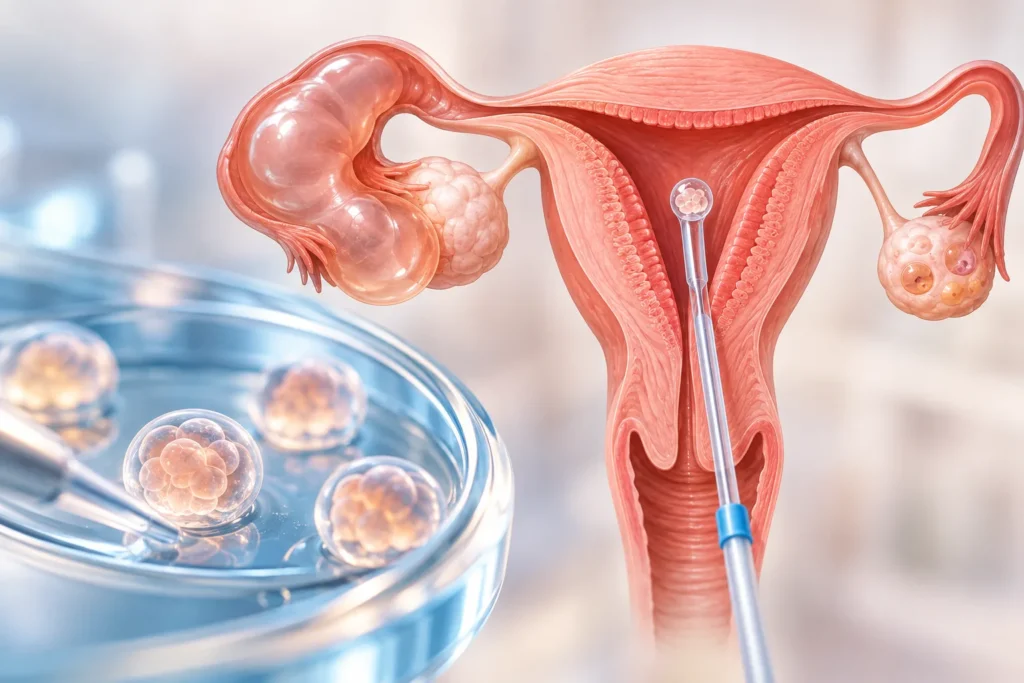
A diagnosis of hydrosalpinx before in vitro fertilization often raises questions: since the treatment bypasses the fallopian tubes, why does a blocked tube need to be treated? The explanation lies in the fluid that can flow back into the uterus and affect implantation before embryo transfer. Assessing the hydrosalpinx is part of treatment planning, based on each woman's findings and history.
What Is Hydrosalpinx
Hydrosalpinx is the swelling of a fallopian tube with fluid, usually because of a blockage at the end closest to the ovary. There may also be damage to the tubal lining and to the fimbriae, which help pick up the egg. The condition can affect one or both tubes.
The most common causes are:
- Past pelvic inflammation, very often from chlamydia or other sexually transmitted infections, even if there were no symptoms at the time of infection.
- Endometriosis, which causes adhesions around the fallopian tubes.
- Previous abdominal or pelvic surgery, such as an appendectomy with peritonitis.
- A past ectopic pregnancy or tubal surgery.
Hydrosalpinx often causes no symptoms at all. Some women report chronic pelvic pain or watery vaginal discharge, but in most cases it is found during an evaluation for infertility.
How Hydrosalpinx Affects Implantation
An untreated hydrosalpinx is associated with lower implantation and pregnancy rates in IVF. Comparative studies have reported rates about 50% lower, but this is not an individual prediction. The effect appears stronger when the hydrosalpinx is visible on ultrasound.
Different mechanisms have been proposed to explain this association:
1. Toxic effect of the fluid on the embryo
The fluid may contain inflammatory factors that adversely affect the uterine environment. A possible direct effect on the embryo is one of the proposed mechanisms; it does not mean that every hydrosalpinx contains an active infection.
2. Mechanical "flushing" of the uterus
Fluid flowing into the uterus may hinder contact between the embryo and the endometrium. Mechanical "flushing" is described as a possible mechanism, not as a certainty that happens in every case.
3. Reduced endometrial receptivity
Inflammation may affect endometrial functions involved in implantation. The morphological quality of an embryo is not enough to rule out this effect.
Appropriate treatment before embryo transfer may improve IVF outcomes. It does not guarantee pregnancy, as the outcome also depends on other factors.
How It Is Diagnosed
Hydrosalpinx is diagnosed with imaging tests and, when needed, laparoscopy:
- Transvaginal ultrasound: may show an elongated, tube-shaped, fluid-filled structure near the ovary. A hydrosalpinx that is visible on ultrasound has been linked to poorer IVF outcomes.
- Hysterosalpingography (HSG) or hysterosalpingo-contrast sonography (HyCoSy): show whether the fallopian tubes are open and whether the contrast medium collects in a dilated end of the tube.
- Diagnostic laparoscopy: allows direct assessment of the fallopian tubes, adhesions and endometriosis, and is often combined with treatment in the same procedure.
Hydrosalpinx should not be confused with ovarian cysts. Telling them apart requires experience in ultrasound, because the treatment approach is completely different.
When Treatment Is Needed Before IVF
Treatment of the hydrosalpinx is usually discussed before embryo transfer, especially when it is visible on ultrasound or connects with the uterus. The decision takes into account:
- The size and visibility of the hydrosalpinx.
- Whether it affects one or both fallopian tubes.
- The age and ovarian reserve of the woman.
- Previous failed embryo transfers.
- Any coexisting endometriosis or extensive adhesions.
With limited ovarian reserve, stimulation and egg retrieval, with cryopreservation of the embryos, may be discussed first, followed by treatment of the tube before the transfer. The order of interventions depends on age, findings and potential risks.
Treatment Options
Laparoscopic salpingectomy
Removing the affected tube with laparoscopic tubal surgery is an established option before IVF. It is usually done through small incisions with a short hospital stay, but recovery varies. Care is needed to protect the blood supply to the ovary, especially when adhesions are present. The possible effect on ovarian function and the surgical risks are discussed before the procedure. 3D technology in laparoscopy may help with depth perception, without eliminating these risks.
Proximal tubal occlusion
Blocking the tube close to the uterus can be an alternative, especially when extensive adhesions increase the risk of removing it. The goal is to stop fluid from flowing back into the uterine cavity.
Ultrasound-guided aspiration
Ultrasound-guided aspiration of the fluid may be considered in selected cases. Because the fluid often reaccumulates and the evidence is weaker, it is not considered an equivalent solution for all women.
Surgical repair of the fallopian tube
In young women with a small hydrosalpinx and a healthy tubal lining, opening the end of the tube may be considered with the aim of natural conception. The chance of success depends heavily on the tubal damage, and this option carries an increased risk of ectopic pregnancy.
What to Expect After Treatment
Embryo transfer is scheduled after recovery, according to the surgical outcome and the preparation protocol. Having one healthy fallopian tube does not prevent IVF. After removal of both tubes, IVF remains a way to achieve pregnancy, with chances that depend on the overall reproductive profile.
From diagnosis to embryo transfer: the steps in practice
Treating hydrosalpinx before IVF is not a single step. It is a series of decisions that needs to be coordinated with the treatment cycle. A typical course looks something like this:
- Confirming the finding. Transvaginal ultrasound is usually repeated at a different phase of the cycle, because the hydrosalpinx may be seen more clearly on certain days. When in doubt, hysterosalpingography (HSG) helps show whether the tube is blocked and dilated.
- Ovarian reserve testing. AMH and the ultrasound follicle count show whether there is time to do the surgery first or whether egg retrieval should come first.
- Preoperative testing. Blood tests, screening for active infection and, when needed, an anesthesia assessment.
- Laparoscopy. During the same procedure, the other tube, the ovaries, any adhesions and possible endometriosis are assessed.
- Recovery and endometrial preparation. Once the body has recovered, the transfer cycle begins, with a fresh or frozen embryo.
This planning reduces delays. It also avoids transferring embryos into a uterus that is still affected by fluid from the tube.
Unilateral or bilateral hydrosalpinx: what changes in the plan
When the hydrosalpinx affects only one side and the other tube is open, the discussion gains an extra dimension. After the affected tube is treated, some younger women with good ovarian reserve and a partner with a normal semen analysis may consider a period of trying for natural conception or with intrauterine insemination (IUI). The decision depends on age, the duration of infertility and the other factors involved.
With bilateral hydrosalpinx, things are clearer. Natural conception is very unlikely and IVF is the main route. Here, treating both tubes before the transfer is almost always discussed.
- Unilateral: a possible option of trying naturally after treatment, depending on the couple's profile.
- Bilateral: IVF as the main route, with treatment of the tubes before the transfer.
- In both cases: the assessment of ovarian reserve determines the order of the steps.
When hydrosalpinx appears during ovarian stimulation
Sometimes a small hydrosalpinx that was not visible before becomes visible or enlarges during stimulation. High estrogen levels increase fluid production. The team then has a few options:
- Freeze-all. The embryos are frozen and the transfer is postponed until the tube has been treated. This is the most common and safest option.
- Aspirating the fluid during egg retrieval. This can be done in selected cases, with antibiotic cover, but the fluid often returns within a few days.
- Going ahead with a fresh transfer. This is generally not preferred when the hydrosalpinx is visible, because of the possible effect on implantation.
Embryo cryopreservation is not affected by the hydrosalpinx. The issue concerns the uterine environment at the time of transfer, not the embryos themselves.
Hydrosalpinx, infection and prophylactic antibiotics
A hydrosalpinx is usually the imprint of an old inflammation rather than an active infection. Even so, the stagnant fluid can become infected when procedures are performed in the pelvis. That is why, in women with a known or suspected hydrosalpinx:
- testing for chlamydia and other sexually transmitted infections often comes first, with treatment of both partners when the result is positive,
- HSG and egg retrieval are usually performed with prophylactic antibiotics, according to the center's protocol,
- after egg retrieval, fever, severe pain that gets worse instead of easing, or foul-smelling vaginal discharge need prompt medical evaluation, because a pelvic abscess can rarely develop.
Preparation and recovery after laparoscopic salpingectomy
Most women go home the same day or the next day. Recovery varies, but a few points apply to almost everyone:
Before the procedure
- Ask whether the uterus will also be checked with hysteroscopy under the same anesthesia, to avoid a second procedure.
- Discuss what will happen if adhesions or endometriosis are found that were not visible on ultrasound.
- Tell us about medications, allergies and anticoagulants.
The first days after
- Mild pain at the incisions and shoulder pain from the laparoscopy gas are expected and ease within a few days.
- Walking from the first day helps bowel function and lowers the risk of blood clots.
- Most women return to office work within one to two weeks.
When to contact us right away
- Fever above 38°C (100.4°F) or chills.
- Redness, pus or opening of an incision.
- Worsening abdominal pain, vomiting or inability to pass gas.
- Pain or swelling in the calf, shortness of breath.
Myths and facts about hydrosalpinx in IVF
- "Since IVF bypasses the fallopian tubes, this does not concern me." The fluid can reach the uterus, which is why hydrosalpinx matters even when the tubes are not used.
- "Without fallopian tubes, I cannot get pregnant." IVF does not need the fallopian tubes. The embryo is placed directly into the uterus.
- "Antibiotics will make the hydrosalpinx go away." Antibiotics treat an active infection, but they do not reverse the dilation and damage of the tube.
- "Removing the tube causes early menopause." With a careful technique that preserves the blood supply to the ovary, the data do not show such an association.
- "After surgery, success is guaranteed." Treatment removes a negative factor, but the outcome depends mainly on age and embryo quality.
Conclusion
A hydrosalpinx can lower the chances of implantation, even when the embryos have good morphology. Diagnosis and a discussion of treatment before embryo transfer support proper planning, without guaranteeing a specific outcome.
Dr. Panagiotis Polyzos combines his experience in assisted reproduction at the Institute of Life IASO with laparoscopic surgery, so that diagnosis, surgery and IVF are planned as one integrated plan. For a personalized assessment, book an appointment at the Athens or Volos office.
Frequently Asked Questions
Can I have IVF if I have a hydrosalpinx?
IVF is possible, but treatment of the hydrosalpinx needs to be discussed before the transfer. In some cases, egg retrieval and embryo freezing may come first.
How much does hydrosalpinx reduce the chances of success?
Significantly lower success rates have been reported in women with an untreated hydrosalpinx. Treatment can improve them, but there is no single success rate that applies to every woman.
Does removing the fallopian tube affect the ovaries?
The data on ovarian response after salpingectomy are generally reassuring, but they do not rule out an effect in every case. Anatomy, adhesions and surgical technique are all taken into account.
Is draining the fluid during egg retrieval enough?
Aspiration may help temporarily, but the fluid often reaccumulates. That is why salpingectomy or proximal tubal occlusion are considered more reliable solutions.
How soon after surgery can embryo transfer take place?
The timing is individualized according to recovery, the type of surgery and endometrial preparation. It is not determined only by the arrival of the next period.
Can a hydrosalpinx go away on its own?
A hydrosalpinx is caused by permanent blockage and damage of the tube, so it does not go away on its own. Its size can change during the cycle, so it sometimes looks smaller or is not visible at all on ultrasound, but this does not mean it has healed.
Can a hydrosalpinx come back after the tube is opened?
Yes. After surgical opening of the end of the tube, the opening can close again and fluid can reaccumulate. That is why repair is chosen mainly when the goal is natural conception, while salpingectomy or proximal tubal occlusion is usually preferred before IVF.
Does the HSG need to be repeated after salpingectomy?
Usually not, because laparoscopy shows directly what was done to each tube. Follow-up after surgery is mainly by ultrasound, to assess the uterus and ovaries before preparing for the transfer.
How will I know whether the tube should be removed or blocked?
The choice is usually made during laparoscopy, depending on the adhesions and the anatomy around the ovary. You will find more information about the techniques on the page about laparoscopic tubal surgery.