


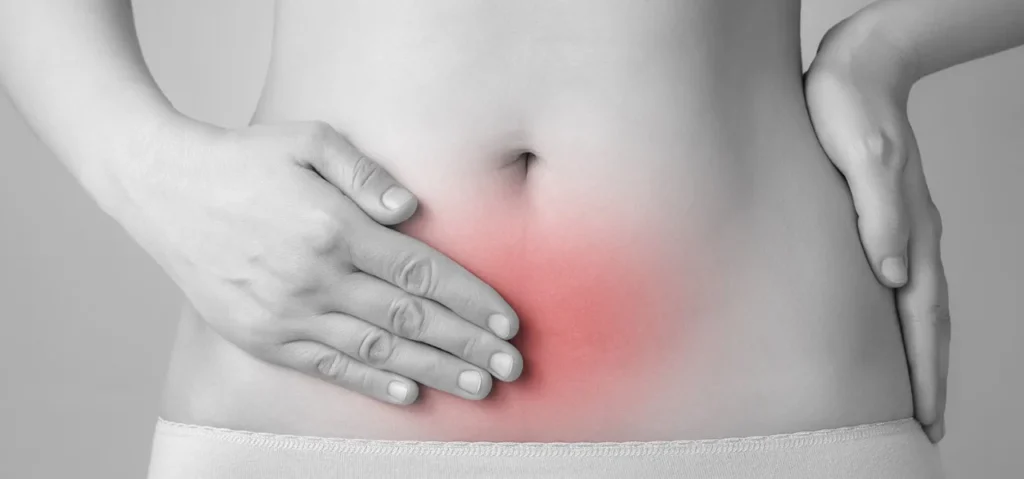
Dysmenorrhea is defined as prolonged pain and cramps in the lower abdomen and pelvis just before and during the first days of the period. For many women, period pain can be severe enough to interfere with daily activities for a few days each month. Gynecological conditions such as endometriosis or uterine fibroids can cause more severe dysmenorrhea. Treating the cause is key to reducing and possibly eliminating the pain. Period cramps that are not caused by another gynecological condition tend to ease with age and very often improve after childbirth.
Symptoms
- Very severe pain, mainly in the lower abdomen
- Pain that starts 1 to 3 days before your period, peaks 24 hours after the start of your period and subsides in 2 to 3 days
- Pain that radiates to the lower back and thighs
- Some women also experience nausea, diarrhea, headache, dizziness.
Causes
During your period, the uterus contracts slightly to help expel the blood.
Prostaglandins involved in pain and inflammation trigger uterine muscle contractions. Higher levels of prostaglandins are associated with more intense menstrual cramps. Period cramps can be aggravated by:
- Endometriosis. Tissue that behaves like the lining of the uterus grows outside the uterus, most often on the fallopian tubes, the ovaries or the tissue lining your pelvis, the peritoneum.
- Fibroids of the uterus.
- Adenomyosis. The tissue that lines your uterus begins to grow into the muscular walls of the uterus.
- Pelvic inflammatory disease. This infection of the female reproductive organs is usually caused by sexually transmitted bacteria.
- Cervical stenosis. In some women, the opening of the cervix is small enough to block menstrual flow, causing a painful increase in pressure in the uterus.
Complications
Dysmenorrhea does not usually cause other medical complications, but it can affect your daily life, school, work and social activities. However, some conditions such as endometriosis can cause fertility problems. Pelvic inflammatory disease can scar your fallopian tubes, increasing the risk of a fertilized egg implanting outside your uterus (ectopic pregnancy).
Diagnosis
Your gynecologist will take your medical history and perform a physical exam, including a pelvic exam. During the pelvic exam, the doctor checks for anything unusual in your reproductive organs and looks for signs of infection. Your doctor may also recommend certain tests, such as:
- Ultrasound of the internal genital organs
- CT scan.
- Magnetic resonance imaging
- Laparoscopy. Although it is usually not needed to diagnose dysmenorrhea, laparoscopy can help detect an underlying condition such as endometriosis, adhesions, fibroids, ovarian cysts or ectopic pregnancy.
Treatment
To ease your period pain, your doctor may recommend:
- Painkillers
Non-steroidal anti-inflammatory analgesics, such as ibuprofen or naproxen, in regular doses starting the day before your period starts, can help control the pain from cramps. Start taking the pain reliever at the beginning of your period or as soon as you feel symptoms, and continue to take the medicine as directed for two to three days or until your symptoms disappear.
- Hormones
Birth control pills that contain hormones that prevent ovulation and reduce the severity of dysmenorrhea symptoms. These hormones can also be given in several other forms: an injection, a skin patch, an implant placed under the skin of your arm, a flexible ring you insert into your vagina or an intrauterine device (IUD).
Lifestyle and complementary therapies
Besides getting enough sleep and rest, you can also try to:
- Exercise regularly. Physical activity, including sex, helps relieve period cramps for some women.
- Use local heat. A warm bath or the use of a heating pad or hot water bottle on your lower abdomen can reduce period cramps.
- Try dietary supplements. A number of studies have shown that vitamin E, omega-3 fatty acids, vitamin B-1 (thiamine), vitamin B-6 and magnesium supplements can reduce menstrual cramps.
- Reduce stress. Psychological stress can increase the risk of menstrual cramps and their severity.
- Acupuncture
- Transcutaneous electrical nerve stimulation (TENS).
- Herbal medicines. Certain herbal products, such as pycnogenol and fennel, may offer some relief from period cramps.
Primary and secondary dysmenorrhea: what is the difference
Primary dysmenorrhea is the term for period pain with no underlying condition. It usually begins one to two years after the first period, is caused by prostaglandins that make the uterus contract, and often eases over the years or after childbirth.
Secondary dysmenorrhea is caused by a gynecological disease: endometriosis, adenomyosis, fibroids, polyps, pelvic inflammatory disease or cervical stenosis. It usually appears after age 25, gets progressively worse and may come with pain during sex, heavy periods or pelvic pain outside of periods.
How the diagnosis is made
Your history gives most of the answers: when the pain started, how long it lasts and whether it responds to painkillers. A gynecological exam and transvaginal ultrasound follow. When endometriosis is suspected, you may need an MRI or laparoscopy.
Treatment of dysmenorrhea
- Non-steroidal anti-inflammatory drugs (NSAIDs), started at the first symptoms or one day before your period.
- Hormonal contraception (pill, ring, hormonal IUD), which reduces prostaglandin production and menstrual flow.
- Treating the cause in the secondary form, with medication or surgery.
For simple, everyday ways to find relief at home, see the article Period pain: what helps.
How dysmenorrhea works: why the uterus hurts
Shortly before your period, progesterone drops. This drop releases large amounts of prostaglandins from the endometrium, mainly PGF2α. These substances cause strong, irregular contractions of the myometrium, raise the pressure inside the uterus and temporarily reduce its blood supply. Muscle that does not get enough oxygen hurts, just as a muscle hurts when it cramps.
The same prostaglandins enter the bloodstream and explain the accompanying symptoms: nausea, diarrhea, headache, dizziness. In studies, women with primary dysmenorrhea have significantly higher prostaglandin levels in menstrual blood than women without pain. This is also why non-steroidal anti-inflammatory drugs, which block their production, are the first-line treatment.
Risk factors
Some women are more likely to develop primary dysmenorrhea:
- age under 30
- first period before age 12
- heavy or prolonged periods
- smoking
- a family history of painful periods
- low body mass index
- anxiety and depression
Vaginal birth and older age are often linked to milder symptoms, although this is not true for everyone.
Signs that dysmenorrhea is secondary
The gynecologist looks for specific “red flags” that point to an underlying condition and lead to further testing:
- the pain started after years of painless periods or after age 25
- it gets worse year after year
- it lasts beyond the first two to three days or also occurs outside your period
- it comes with pain during sex, or pain with bowel movements or urination during your period
- there is abnormal bleeding, heavy periods or bleeding between cycles
- it does not respond to properly taken anti-inflammatories or hormonal treatment after three to six months
- there is also difficulty conceiving
Not responding to treatment is perhaps the most useful clue. In that case, endometriosis should be actively investigated, even in teenagers.
Adenomyosis: an often undiagnosed cause of secondary dysmenorrhea
In adenomyosis, endometrial tissue grows into the muscular wall of the uterus. Every month it bleeds inside the muscle, and the uterus becomes enlarged and tender. It typically causes severe dysmenorrhea along with heavy periods and a feeling of heaviness in the pelvis. It is more common in women over 35 who have had children, but it is increasingly diagnosed in younger women too.
Diagnosis is now made noninvasively, with a specialized transvaginal ultrasound or MRI. Treatment usually starts with the levonorgestrel hormonal IUD or with progestins. When symptoms persist and the woman does not want another pregnancy, hysterectomy is a definitive solution.
Medication for dysmenorrhea: options and limitations
Non-steroidal anti-inflammatory drugs (NSAIDs)
Ibuprofen, naproxen and mefenamic acid are similarly effective in large reviews. If one drug does not help after two to three cycles of correct use, it is worth trying another before treatment is considered a failure. Paracetamol (acetaminophen) is less effective, but it is an alternative when anti-inflammatories are contraindicated.
Anti-inflammatories need caution or should be avoided in:
- an active or recent peptic ulcer or stomach bleeding
- asthma that worsens with aspirin
- kidney failure
- allergy to anti-inflammatories
- use of anticoagulants
Hormonal treatments
Combined hormonal preparations in a pill, ring or patch thin the endometrium and reduce prostaglandins. Continuous use, without a monthly break, is often more effective than the classic regimen. Progestins, such as dienogest, are used especially when there is endometriosis. The hormonal IUD significantly reduces both pain and menstrual flow and is a good option for adenomyosis.
When first-line options are not enough
In confirmed or probable endometriosis that is not under control, the doctor may discuss GnRH analogs or antagonists. They create a temporary low-estrogen state, so they are usually combined with a low dose of hormones to protect the bones and limit hot flashes.
Surgical treatment for secondary dysmenorrhea
Surgery is not a treatment for primary dysmenorrhea. It has a role when there is an anatomical cause that can be corrected:
- Laparoscopic removal of endometriosis lesions or endometriomas: reduces pain and may improve fertility in selected cases.
- Hysteroscopy: to remove polyps or fibroids that protrude into the uterine cavity.
- Myomectomy: removal of fibroids while preserving the uterus.
- Hysterectomy: a definitive option for women who have completed their family and have not been helped by other treatments.
The decision is made individually, based on age, the wish for pregnancy, the extent of the disease and how much quality of life is affected.
Dysmenorrhea in adolescence: when more testing is needed
In teenagers, dysmenorrhea is almost always primary. However, international guidelines recommend investigation when pain does not improve after three to six months of anti-inflammatory and hormonal treatment, because endometriosis can begin in adolescence and is often diagnosed years late.
More rarely, severe cyclical pain from the very first periods is caused by a congenital anomaly of the uterus or vagina that blocks the flow of blood. A simple ultrasound is usually enough to rule it out. For everyday practical tips on relief at home, see the guide to period pain.
How the severity of dysmenorrhea is assessed
Pain is subjective, so the doctor uses simple tools to measure it and track whether treatment is working. The most common is the 0 to 10 scale, where 0 means no pain and 10 the worst pain you can imagine.
Just as important is how the pain affects your life. For two to three cycles, write down:
- how many days you missed from work, school or other obligations
- how many painkiller tablets you needed and whether they helped
- whether the pain woke you up at night
- whether there was pain during sex, urination or bowel movements
This diary separates mild from severe dysmenorrhea and shows when treatment needs to be stepped up or imaging is needed.
For a personalized assessment of your case, book an appointment with Dr. Panagiotis Polyzos at his office in Athens or Volos.
Frequently Asked Questions
What is dysmenorrhea?
It is the medical term for painful periods: cramps in the lower abdomen that may spread to the lower back and thighs, sometimes with nausea, diarrhea or headache.
How do I tell primary from secondary dysmenorrhea?
Primary dysmenorrhea starts in adolescence, lasts one to three days and eases with painkillers. Secondary dysmenorrhea appears later, gets worse over time and is often accompanied by other symptoms.
Can dysmenorrhea mean endometriosis?
Yes. Severe pain that is not controlled with medication, pain during sex or difficulty conceiving are reasons to be checked for endometriosis.
Do birth control pills help?
In most women they noticeably reduce pain and bleeding. Your gynecologist chooses the preparation based on your history.
Does dysmenorrhea affect fertility?
Primary dysmenorrhea does not. In secondary dysmenorrhea, fertility depends on the condition causing it, which is why early diagnosis matters.
What is adenomyosis and how is it related to dysmenorrhea?
It is the growth of endometrial tissue into the muscular wall of the uterus. It causes secondary dysmenorrhea, usually together with heavy periods and an enlarged, tender uterus. It is diagnosed with a specialized ultrasound or MRI and is often treated with a hormonal IUD.
Is laparoscopy needed to diagnose dysmenorrhea?
Not in most cases. Primary dysmenorrhea is diagnosed from your history and the response to treatment. A laparoscopy has a role when there is strong suspicion of endometriosis that is not controlled with medication, or when there is also infertility.
Can dysmenorrhea start after 30?
Yes, and in that case it is more likely to be secondary. New or worsening period pain in an adult woman needs a gynecological exam and ultrasound to check for endometriosis, adenomyosis, fibroids or polyps.
Which anti-inflammatory is most effective for dysmenorrhea?
Studies do not show a clear advantage for any one drug. Ibuprofen, naproxen and mefenamic acid have similar results. What matters is the right dose, starting early and choosing the medication based on your history.